
Chemistry-4H
Class Head: Dr. K.W. Muir
CLASS HANDBOOK
1996-1997

Chemistry -4H

Course Head: Dr Kenneth W Muir
Course Secretary: Miss Elizabeth McLean

 	CONTENTS

	General information
	Project timetable
	Safety
	Guidelines for writing a thesis
	Booklist
	Timetable


POLICY ON SUMMATIVE ASSESSMENT
All feedback on coursework used in assessment, including mid-year class exam/class test marks and
laboratory grades, is strictly provisional for your guidance only, and is subject to ratification by the
Board of Examiners and external examiners at the end of the academic year. You must retain all
copies of assessed work (lab notebooks, exam scripts, etc.) and have them available for inspection by
the examiners if requested at the end of the year. (You will be given reasonable advance warning
should this be required.)

 GENERAL INFORMATION:CHEMISTRY-4H                                SESSION  1996-97

The Class Head is Dr Kenneth W Muir. In the event of illness or other reasons for absence, Dr Muir
should be notified as soon as possible and, if appropriate, a relevant medical certificate should be
handed in to Mrs E Hughes Room A4-04.

LECTURE COURSES

Compulsory Lecture Courses: The nine compulsory courses are listed in the timetable. They are given
during weeks 1 -12.

Option Courses: You must attend five option courses. You can choose any five from the list of twelve
shown in the timetable. The courses on offer cover a wide range of topical subjects in modern
chemistry.

All courses consist of eight lectures. They will be given in the Physical Lecture Theatre.

TUTORIALS

Inorganic:	Term 2: No formal tutorials. Students have a problem book. All inorganic staff will
post office hours.
Organic:	Term 1: Weeks 1-10  Tuesdays at 4 pm.
Physical:	Term 1: Weeks 2-10   Wednesdays at 4 pm in the Organic Lecture Theatre.

CLASS CERTIFICATES

You need to obtain a class certificate before you can sit the final degree examinations. To be certain of
a class certificate you must:

(a)	regularly attend lectures and tutorials,
(b)	carry out a research project in weeks 2-18 following the timetable given later in this
handbook,
(c)	give a short oral presentation on your project in week 19, and
(d)	provide the Chemistry Department with one copy of a thesis on your project by the first day
of the third term.

EXAMINATIONS

The degree examinations consist of a research project and four three-hour written papers. There is
also a third year carry-over mark.
The research project will be assessed on the basis of the thesis (40%), the work performed during the
project (40%), and an oral examination on the contents of the thesis (20%).
All students must be available for oral examination by the external examiners on Tuesday, 17th June,
1997. This is an integral part of the degree examination.

CAREERS TALK AND DISCUSSION

Monday 29th October 1pm Organic Lecture Theatre.
Dr N Winterton, ICI, "To do or not to do a PhD", followed by open ended discussion.
Professor Winfield and Dr Muir will arrange individual interviews for all students early in Term 1 to
discuss their choices of a future career.

LECTURES

Alchemist Club and local R.S.C. meetings: Attendance at these talks, which are held on Thursdays at
4 pm,  and at the Irvine Review Lectures is recommended and encouraged.
Irvine Review Lectures: St. Andrews, Friday 25th April, 1997. The subject this year is Pharmaceutical
Chemistry


 FOURTH YEAR PROJECT TIMETABLE

Week 1		Project supervisors announced to class.
		Students contact supervisors and agree on projects.
Week 2		Supervisors give students two copies of a synopsis of the project including a title and
leading references.
		One copy of the project synopsis should be given to KWM.
 		Practical work may begin from the start of week 2 provided a COSHH form has been
completed, signed by the supervisor and given to Mrs M  Nutley (Room B4-20a). If the nature of the
research changes during the project new COSHH forms must be completed.
Week 4		Project assessors announced.
		Students contact assessors.
Week 10		Students give their thesis introduction to KWM who will pass it on, with
any comments, to the supervisor. The supervisor will return the introduction in the first week of term
2.
		The Introduction should be around 5 -10 pages, word processed, and include a full
list of references.
Week 18		Friday: Last day of practical work.
Week 19		Thesis talks (15 mins - not assessed).
Week 20		Friday: Final draft of thesis approved by supervisor.
Week 21		Monday: Last day for submission of theses. One copy to be supplied to Mr
R Munro - he will make a copy (or copies) for the Department, and bind and return the original.
Weeks 22-23		Oral examinations. These will be conducted by the assessor and a second
member of staff. The supervisor will not be present.


SAFETY

The Departmental Safely Committee have issued the following guidelines:

1.	Experimental work should normally not start before 9.00 am and should normally finish by
5.00 pm.

2.	Should it be necessary to work outwith these hours for short periods this must be approved by
the supervisor and the usual rules of late working will apply. If the supervisor has to leave before
experimental work is complete written permission must be given and in such cases a designated proxy
( academic, post-doctoral or senior technical staff) must be present in the building.

3.	Access to IT equipment will be available only when Janitors are present in the building.


GUIDELINES FOR PRESENTING AND WRITING A FOURTH YEAR THESIS


The thesis counts for 40% of the marks assigned to the project and, in addition, is the only tangible
result of the sixteen weeks of work which can be shown to the External Examiners. It is therefore
important that you do not let yourself down by a badly written or produced thesis.

Technical Points

The thesis should be word processed (the Department now has an adequate number of PC's with
WORD 6 installed).

The font should be clear. Fonts normally used are Times New Roman or Arial (usually 10, 11 or 12
point). This document is written in Arial 10pt. with main headings in 12 pt bold.

The thesis should use 1.5 line spacing and have a reasonable margin on the left hand side to allow for
binding. (WORD 6 gives default margins of 3.17 cm left and right and 2.54 cm top and bottom which
are acceptable).

Pages should be numbered consecutively, as should diagrams and spectra. Since the word processor
will do the numbering for you, it is easier if you do not include whole page diagrams or spectra in the
page numbering, but this is a matter of choice.

Chemical structures can be drawn using ChemWindow and copied into WORD 6. On the other hand
there is nothing wrong with Xeroxing in structures (and indeed diagrams) provided that the result
looks neat and clear.
References

Referencing work is very important and is frequently badly done. The format shown in the following
examples is that employed by the Royal Society of Chemistry. It should be used unless your supervisor
suggests an alternative.

1. Journal articles: (Journal in italics, year, volume no in bold, page no)

I. A. Fallis, L. J. Farrugia, N. M. Macdonald and R. D. Peacock, J. Chem. Soc. Dalton Trans.,
1989, 931.
P. R. Mallinson and K.W. Muir, J. Appl. Crystallogr., 1985, 18, 51.

other possibilities are:

unpublished work, in press, personal communication.

2. Books: (Title in italics, publisher, place, year, vol no, page if necessary)

International Tables for X-ray Crystallography, Kynoch Press, Birmingham, 1974, vol 4.

3. Theses:

N. M. Macdonald, Ph. D. thesis, University of Glasgow, 1994
P.A. Lovatt, B. Sc. thesis, University of Glasgow, 1993

Content

The thesis should contain

Title page
Acknowledgements
Contents page (with page numbers)

A one page Abstract

Introduction
Experimental Section,
Results and Discussion (or Results and Discussion as separate sections)
Conclusions
References

The above is the logical order, but in some areas it is normal to put the experimental section at the
end - consult your supervisor.

The INTRODUCTION should set the work in context, review previous work (fully referenced),
describe any techniques or theories with which you were unfamiliar when you began the research, and
describe what you intended to do.

The EXPERIMENTAL SECTION should give full experimental details of all reactions or
experiments carried out. It is particularly important to indicate which are literature preparations and
which are novel. If a literature preparation is reported it is important to note if you modified it or if it
behaved in an unexpected way. New compounds should be as fully characterised as possible and it is a
good idea to include the actual spectra of new compounds.

The DISCUSSION is extremely important and is often where students do not do themselves justice. A
project where absolutely nothing has worked can be made interesting by discussing WHY things went
wrong.  In any case the discussion is often where you show how much of the project you understood!

The CONCLUSIONS should summarise the work and suggest how it could be continued in the future.

The ABSTRACT will be similar to the Conclusions but should be concise and incisive - it is the first
thing an examiner will read, and should encourage him or her to read the rest of the thesis!

Finally:  SPELL CHECK YOUR THESIS.


CHEM-3H & CHEM-4H: RECOMMENDED TEXTBOOKS FOR SESSION 1996-97

MOLECULAR MODELS: It is essential that all students possess a set of molecular models.

Orbit Molecular Building System: Organic and Inorganic Chemistry Individual Set, Cochrane,
£10.75. (Approx)


INORGANIC CHEMISTRY: It is essential that all students have a copy of:

Inorganic Chemistry, Second Edition, D F Shriver, P W Atkins and C H Langford, Oxford University
Press, 1994, £19.50.

The following three books are strongly recommended for purchase:

Basic Solid State Chemistry, A R West,John Wiley, £18.50.

Structural Methods in Inorganic Chemistry, Second Edition, E A V Ebsworth, D W H Rankin and S
Craddock, Blackwell, £19.95.
Particularly useful for laboratory and tutorial work and helpful in problem solving.

The Mechanisms of Reactions at Transition Metal Sites, R A Henderson, Oxford Science
Publications, £4.99.

ORGANIC CHEMISTRY:Students should already own

Organic Chemistry, Fifth Edition, R J Morrison and R N Boyd, Allyn/Bacon, £24.00 OR
Organic Chemistry, Third Edition, J McMurry, Brooks/Cole, £23.50.

It is essential that all students have a copy of:

Spectroscopic Methods in Organic Chemistry, Fourth Edition Revised, D H Williams and I Fleming,
McGraw-Hill, £15.95.


PHYSICAL CHEMISTRY: It is essential that all students have a copy of:

Physical Chemistry, Second Edition, R A Alberty and R J Silbey, John Wiley, £21.00.


NOTE:  ALL PRICES ARE SUBJECT TO CHANGE BY PUBLISHERS AT ANY TIME.
 REFERENCE BOOKS HELD IN THE CHEMISTRY BRANCH LIBRARY


INORGANIC CHEMISTRY

Advanced Inorganic Chemistry, Fifth Edition, F A Cotton and G Wilkinson, John Wiley, £26.50.

Chemistry of the Elements, N N Greenwood and A Earnshaw, Pergamon, £29.00.
More of a reference book than a textbook, but contains factual information, particularly for main
group elements, which is more complete than in Cotton and Wilkinson.

Some Thermodynamic Aspects of Inorganic Chemistry, Second Edition, D A Johnson, Cambridge
U.P., £37.50. (Out of Print)

Inorganic Chemistry, Third Edition, A G Sharpe, Longman, £19.99.

Orbitals, Terms and States, M Gerloch, John Wiley, out of print.
A small book which should help to classify difficulties in understanding the nature of orbitals, terms
and states. Relevant to many courses in Inorganic and Physical Chemistry.

The Elements, Their Origin, Abundance and Distribution, P A Cox, O.U.P., £11.95.
Useful background and revision materials for Radiochemistry courses.

A Guide to Modern Inorganic Chemistry, S M Owen and A T Brooker, Longman, £12.99.
Sets out to answer the questions that are asked most often by students. A revision aid.

Heterogeneous Catalysis. Principles and Applications, G C Bond, O.U.P. £ not known.

ORGANIC CHEMISTRY

A Guidebook to Mechanism in Organic Chemistry, Sixth Edition, P Sykes, Longmans, £15.99.

Some Modern Methods of Organic Synthesis, Third Edition, W Carruthers, Cambridge U.P., £19.95.

Guidebook to Organic Synthesis, Second Edition, R K Mackie, D M Smith and R A Aitken,
Longman, £16.99.

Organic Synthesis: The Disconnection Approach, S. Warren, John Wiley & Sons, 1994, £15.95.

Physical Organic Chemistry, N S Isaacs, Longman, £27.99.

Secondary Metabolism, Second Edition, J Mann, Claredon Press, Oxford, £22.50.

Heterocyclic Chemistry, T L Gilchrist, Longman, (Out of print).

Non-Benzenoid Conjugated Carbocyclic Compounds, D Lloyd, Elsevier. (Out of print)

Molecular Biology of the Gene, Volumes 1, & 2 Fourth Edition, J D Watson et al.,
Benjamin//Cummings, £37.95.

Advanced Organic Chemistry - Reactions, Mechanisms and Structure, Fourth Edition, J March, John
Wiley, £24.95.
The definitive reference work which is an excellent and complete source of references.

Organic Chemistry - A Guide to Common Themes, T Kitson, Edward Arnold, £13.99.
A very readable overview of concepts and reaction types.


 PHYSICAL CHEMISTRY

Chemical Applications of Group Theory, Third Edition, F A Cotton, £61.00.

Group Theory for Chemists, G Davidson, Macmillan, £19.50, (Out of print).

Tables for Group Theory, P W Atkins, M S Child and C S G Phillips, O.U.P., £4.95.

Molecular Quantum Mechanics, Second Edition, P W Atkins, O.U.P., £23.50.

Modern Spectroscopy, Second Edition, J M Hollas, John Wiley, £16.95.

Fundamentals of Molecular Spectroscopy, Fourth Edition, C N Banwell, McGraw-Hill, £14.95.

Crystal Structure Analysis: a Primer, Second Edition, J P Glusker and K N Trueblood, O.U.P.,
£23.50.

Symmetry and Structure, S F A Kettle, John Wiley, £15.95.

Polymers, Chemistry and Physics of Modern Materials, J M G Cowie, Blackie, £52.65.

Contemporary Polymer Chemistry, H R Allcock and F W Lampe,Prentice Hall, £80.25.

Principles of Polymer Systems, Third Edition, F Rodriguez, Hemisphere, £45.00.

Speciality Polymers, Dyson, Blackie, £28.00.

Biophysical Chemistry, C R Cantor and P R Schimmel, W H Freeman & Co. £33.95.

Physical Biochemistry, D Friefelder, W H Freeman & Co. £29.95.

Enzyme Structure and Mechanism, A Fersht, W H Freeman & Co. £19.95.

Protein Structure - a practical approach, T E Creighton, IRL Press. £22.50.

Introduction to Protein Structure, C Branden and J Tooze, Garland Publishing. £40.43.

Physical Chemistry, Fourth Edition, P W Atkins, OUP, £24.00.

Principles of Colloid and Surface Chemistry, Second Edition, P C Hiemenz, Marcel Dekker Inc.,

Colloid Science, D H Everett, Royal Society of Chemistry. £70.00.

Introduction to Colloid and Surface Chemistry, Fourth Edition, D J Shaw, Butterworth, Heinemann,
£14.95.


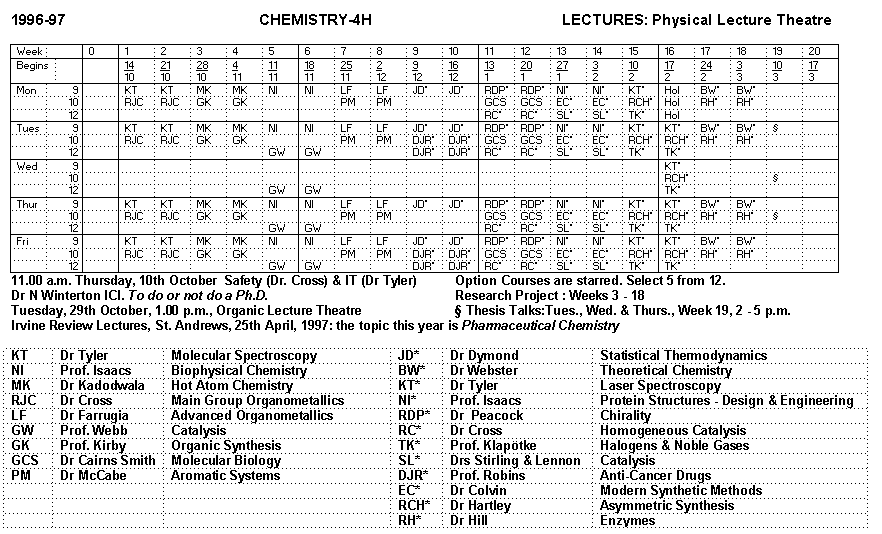
1996-97	CHEMISTRY-4H	LECTURES: Physical Lecture Theatre


H1	Dr Tyler	Molecular Spectroscopy	O1	Dr Dymond 	Statistical
									Thermodynamics
H2	Prof. Isaacs	Biophysical Chemistry	O2	Dr Webster	Theoretical Chemistry
H3	Dr Kadodwala	Hot Atom Chemistry	O3	Dr Tyler		Laser Spectroscopy
H4	Dr Cross	Main Group Organomet	O4	Prof. Isaacs	Protein Structures-
									Design & ngineering
H5	Dr Farrugia	Advanced Organomet	O5	Dr  Peacock	Chirality
H6	Prof. Webb	Catalysis		O6	Dr Cross	Homogeneous
									Catalysis
H7	Prof. Kirby	Organic Synthesis	O7	Prof. Klapötke	Halogens & Noble
									Gases
H8	Dr Cairns Smith	Molecular Biology	O8	Drs Stirling & Lennon	Catalysis
H9	Dr McCabe	Aromatic Systems	O9	Prof. Robins	Anti-Cancer Drugs
						O10	Dr Colvin	Modern Synthetic
									Methods
						O11	Dr Hartley	Asymmetric Synthesis
						O12	Dr Hill		Enzymes
Return to Undergraduate Courses .